
Last updated August 26, 2026
Free on-site gate assessment - hinges, posts, and your LiftMaster or Nice gate operator checked before anything is quoted
The assessment is free and the quote is the invoice.
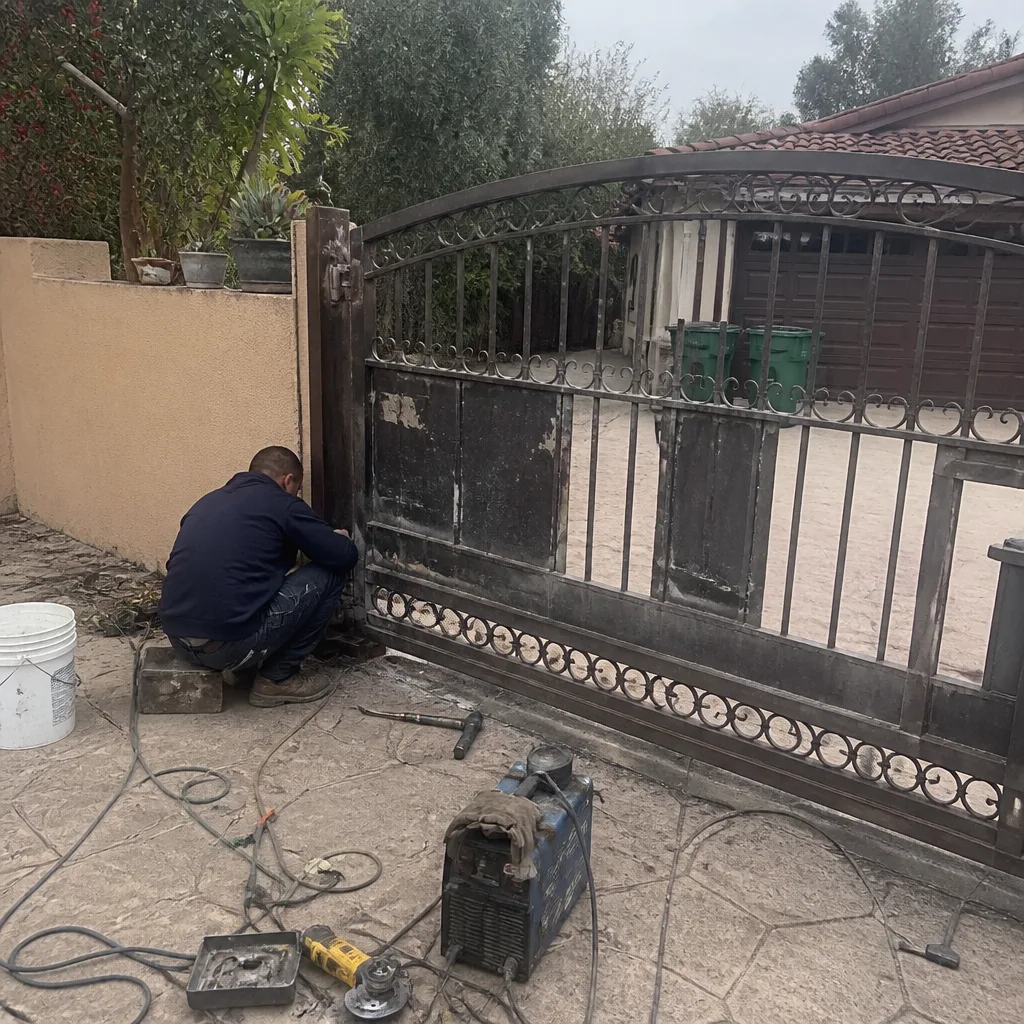 Before
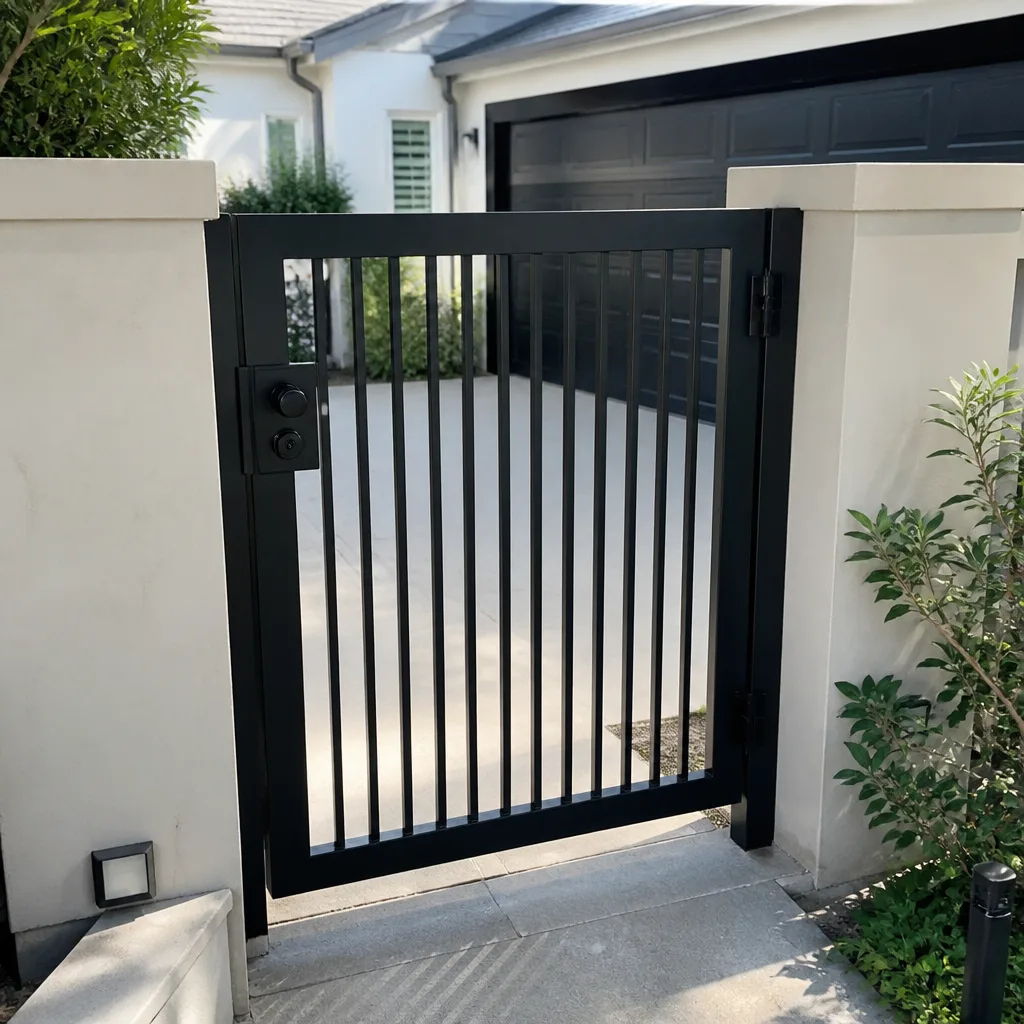 After
After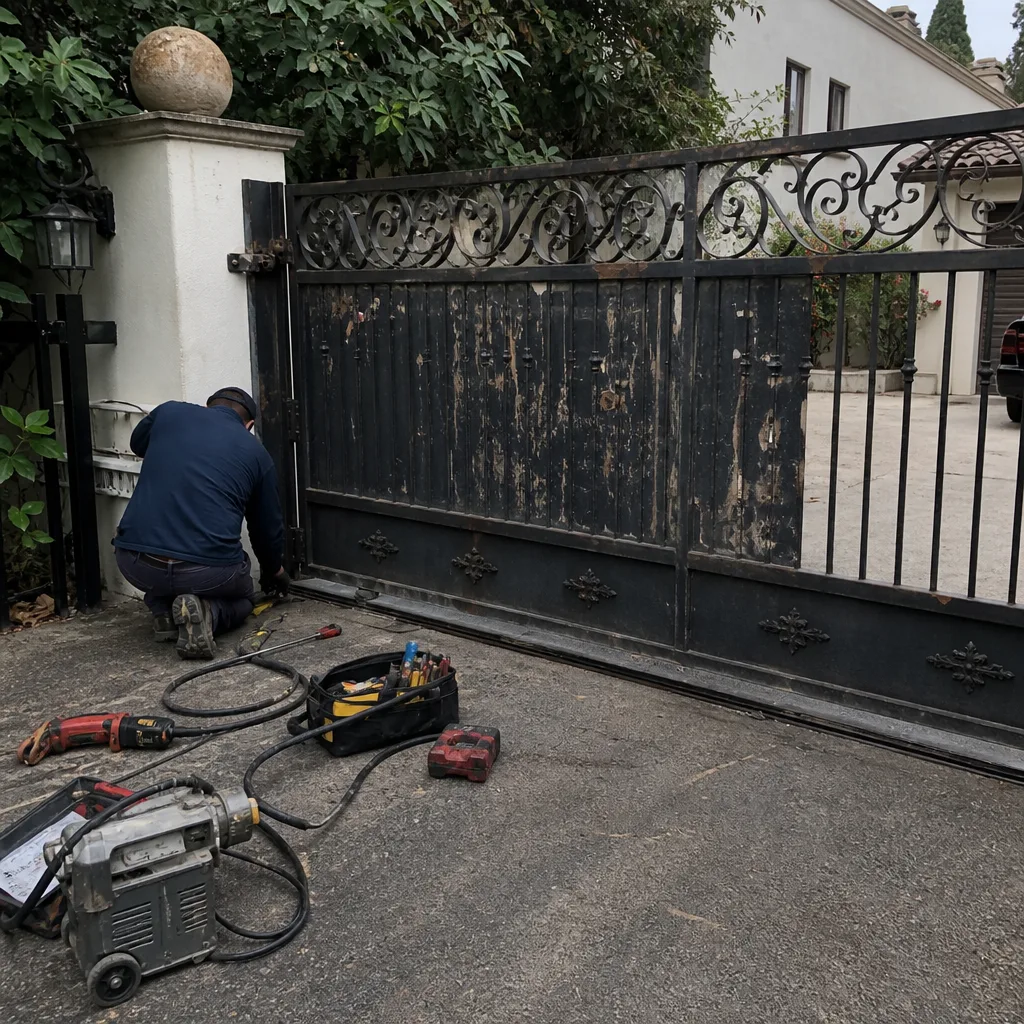 Before
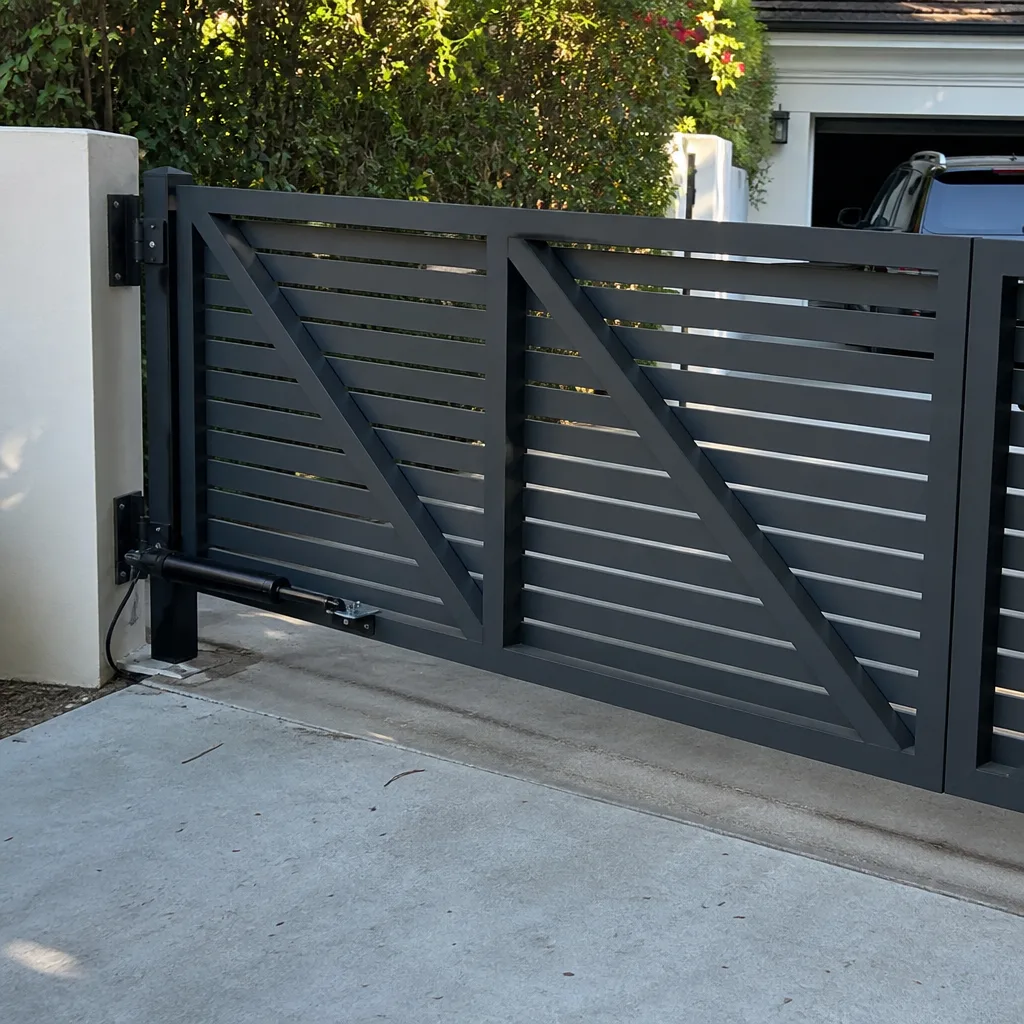 After
After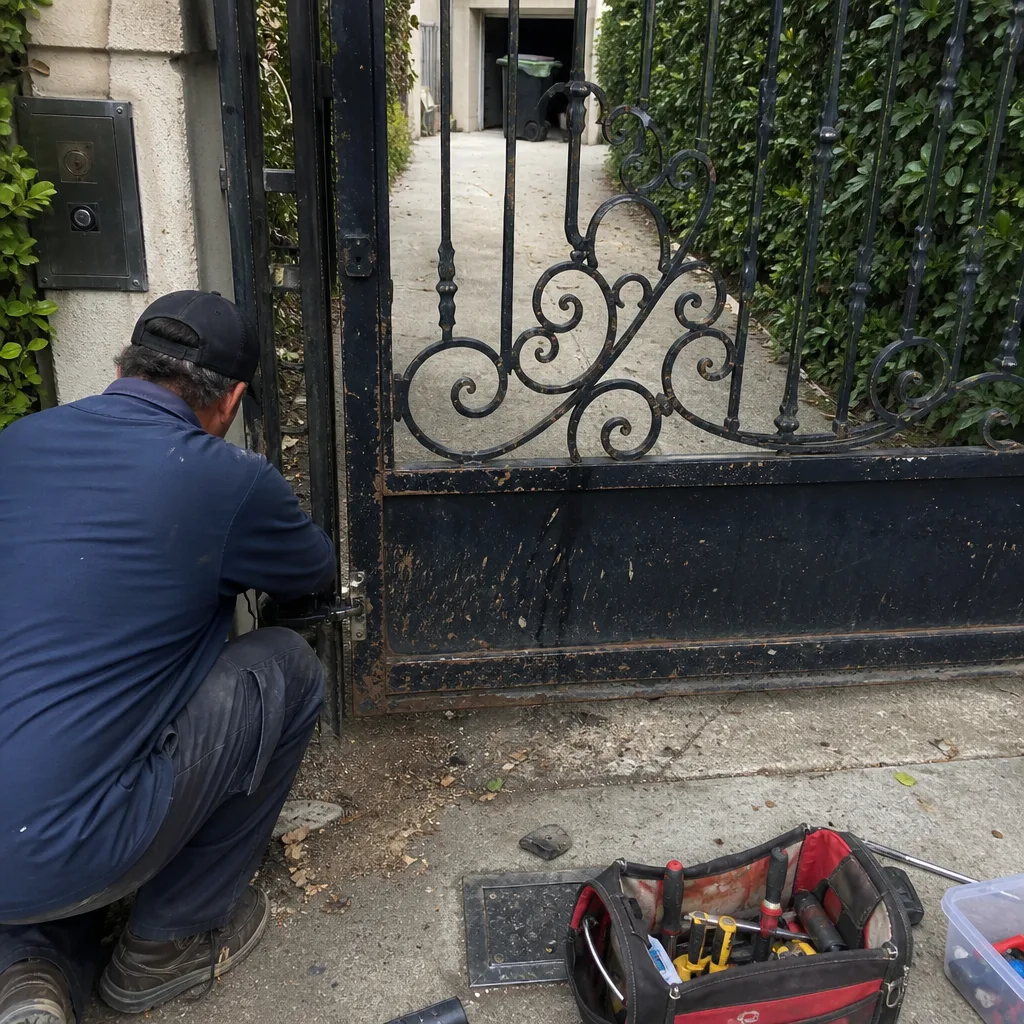 Before
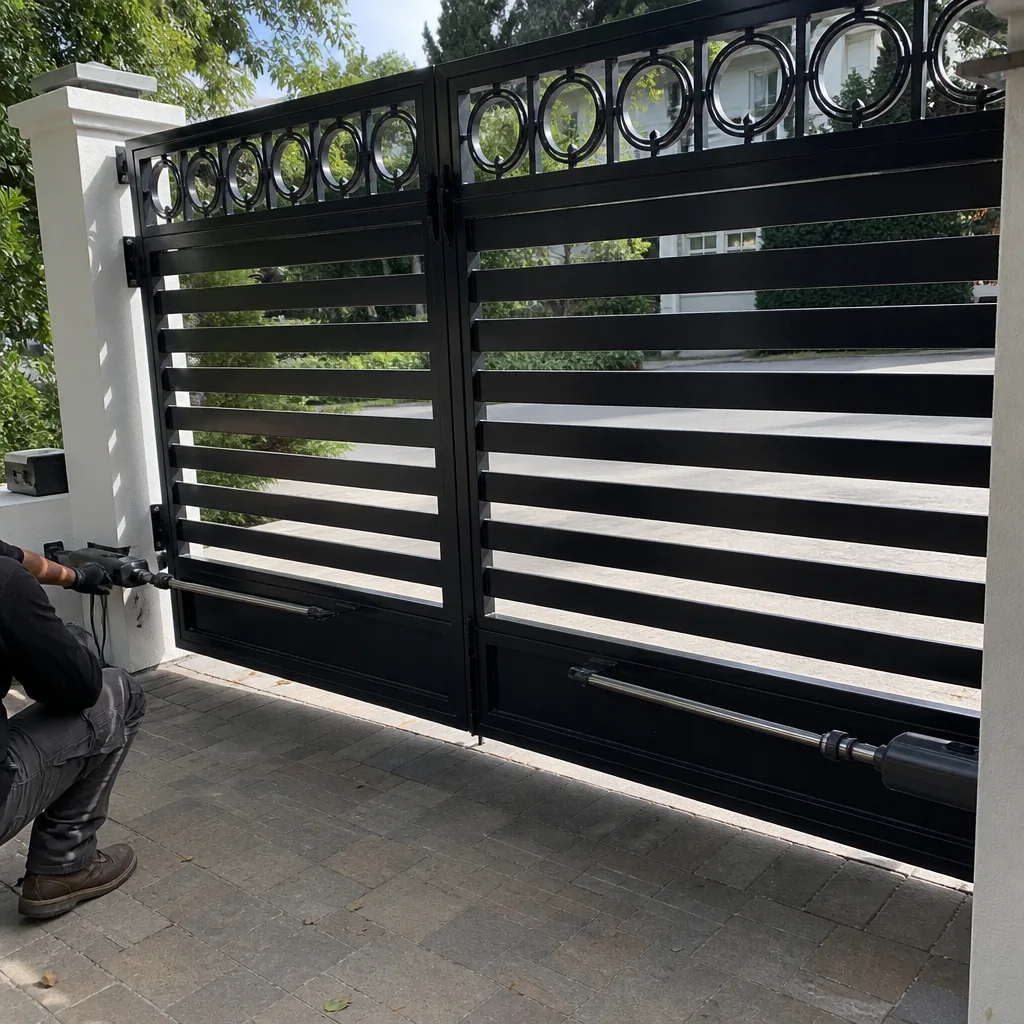 After
AfterGate Repair Warning Signs: A Beverly Hills Homeowner’s Reference Guide
A gate that reverses before it finishes closing is almost never a sensor problem, and that single misread is the most expensive mistake we see in Beverly Hills. It’s usually a force issue, and fixing the wrong one costs you twice: once for the unnecessary sensor replacement, and again when the underlying problem finally forces the gate off its track. This guide maps the seven symptoms we see most often to what’s actually causing them, so you know what you’re looking at before you call anyone. Hal Gatewood has been fixing gates in Beverly Hills since 2001, and most of what follows is written from jobs where someone paid for the wrong fix first.
Quick Answer
The seven most common gate repair warning signs in Beverly Hills are: a gate that reverses mid-cycle, a sagging or dragging gate leaf, grinding or clicking sounds from the operator, rust streaking on pillars or panels, a gate that runs but doesn’t move, erratic remote or keypad behavior, and visible gaps at the hinge post. Each symptom points to a specific root cause. Treat the symptom and you’ll pay twice. Treat the cause and the gate works for another decade.
Table of Contents
- 1. A Gate That Reverses Before It Finishes Closing
- 2. A Sagging or Dragging Gate Leaf
- 3. The Sound Signatures of a Failing Operator
- 4. Rust Streaking: What It’s Actually Telling You
- 5. The Gate That Runs But Doesn’t Move
- 6. Erratic Remote or Keypad Behavior
- 7. Gaps at the Hinge Post
- Common Mistakes to Avoid
- When to Call a Professional
- Frequently Asked Questions
- The Bottom Line
1. A Gate That Reverses Before It Finishes Closing
The gate starts closing, gets three feet from the closed position, then reverses and swings back open. Homeowners in Beverly Hills call this a sensor problem nearly every time. It’s not. The sensor is doing its job. It’s detecting resistance somewhere and telling the operator to stop and reverse.
What it’s actually telling you is that the gate is meeting physical resistance on its way closed. The most common cause is a hinge post that has drifted out of plumb over years of clay soil shifting beneath it. As the post leans, the gate leaf no longer lines up with the catch, the rollers drag against the track, and the operator’s force setting has to work harder to finish the close. When it exceeds the limit, the operator reverses. That’s the design working as intended. The problem is the post, not the sensor.
We see a second cause regularly in Beverly Hills: a gate that was hung on thinner-gauge steel than the job called for. Over a decade of sun and heat, steel flexes and settles. The panel arcs slightly. That arc is enough to catch on the catch post at the last moment, which spikes resistance, which throws the force sensor. The fix is on-site welding to correct the panel or, in some cases, re-hanging the leaf. Replacing the sensor doesn’t touch either problem.
Here’s how to check what you’re dealing with before you spend money:
- Watch the gate close. Note at what point it reverses. If it’s the last few feet only, the problem is almost certainly mechanical alignment, not the sensor.
- Look at the gap between the gate and the catch post while it’s closing. If that gap shrinks unevenly top to bottom, the gate leaf or post is out of level.
- Put your hand on the hinge post while the gate moves. A post that’s loose in the concrete will shift slightly. Tighten the post anchor first. If the symptom disappears, you just saved a sensor.
In our experience, eight of ten gates that reverse near the end of travel in Beverly Hills need hinge post work, panel welding, or both. About two need the force setting on the operator adjusted. Almost none need a new sensor. If a company tells you the sensor is the problem without touching the gate itself, get a second opinion.
2. A Sagging or Dragging Gate Leaf
You can see this one from the street. The gate leaf dips toward the latch side, or it drags against the driveway or track as it opens. It looks sad, and it’s not getting better on its own.
A gate sags in the hinge post, not in the middle. That’s the sentence we repeat most on service calls. The hinge post carries the entire load of the gate, and a post that was set in a shallow footing or with low-grade concrete will begin to lean the first year it’s in the ground. The gate leaf itself almost never bends. What changes is the post’s position. Fix the panel without the post and you’ll fix it twice.
In Beverly Hills, the soil is heavy clay that swells with winter rain and contracts through summer drought. Every wet-dry cycle works the post loose half a millimeter at a time. A gate installed in 2005 has been through twenty winters. That’s enough movement to produce a visible sag.
There’s a second cause that’s cheaper to fix and worth checking first. The hinge pins themselves wear. Over thousands of open-close cycles, the pins get grooved and the leaf drops a fraction of an inch. Replacing hinge pins is a two-hour job with the right tools. Re-plumbing a post is a half-day job. Before you spend money on the post, have someone lift the gate slightly at the latch side. If it moves up and settles back, the hinge pins are worn. If it doesn’t move, the post is the problem.
A dragging gate left unrepaired does compounding damage. The extra friction makes the operator work harder, which shortens its life. The wheels or rollers wear flat spots. The chain or belt stretches to compensate. What started as a worn hinge becomes a $1,400 operator replacement in two years. This is the single most preventable cascade we see in Beverly Hills gate repair.
3. The Sound Signatures of a Failing Operator
Gate operators make noise, but they make distinct kinds of noise, and the difference matters. A healthy opener makes a steady, low-pitched whir that doesn’t change pitch. When something is failing, the sound changes in one of three recognizable ways. Learn all three and you’ll know what to tell the repair tech before they arrive, which saves you diagnostic time and money.
Grinding: A rhythmic, metallic grinding that sounds like two pieces of metal rubbing against each other. This is usually a worn gear inside the operator. Linear and Viking operators both use a metal gear on the output shaft, and when the gear teeth wear down, they don’t mesh cleanly with the drive shaft anymore. The result is a harsh, grating sound that gets louder every week. Left alone, the gear strips completely and the gate stops moving. Early gear replacement is a fraction of a full operator replacement.
Clicking: A rapid click, click, click when the gate starts to move. This is often the operator’s capacitor trying to start the motor and failing. It’s a tell-tale sound on DoorKing operators that have been out in the Beverly Hills heat for a decade, because capacitors degrade faster in sustained high heat. The click is the capacitor cycling and not delivering enough power to turn the motor over. The fix is a new capacitor, which is inexpensive. If you ignore the clicking, the motor eventually burns out trying to start against a dead capacitor. A $40 part becomes a $900 motor.
Humming but not moving: A steady, strained hum that doesn’t result in motion. The motor is getting power, but it can’t move the gate. This is a jam or excessive load. It could be debris in the track, a bound hinge, or a gate that’s settled onto the closed-position stop. Ghost Controls and DoorKing both ship with overload protection that will eventually shut the motor down if left humming. Don’t keep pressing the remote. Find the jam. Fix the jam.
In our experience, half of Beverly Hills operator failures reach us because a sound was ignored for six months. The other half is normal wear. If your opener changes its voice, call somebody. The diagnostic takes ten minutes.
4. Rust Streaking: What It’s Actually Telling You
Rust streaks on white stucco pillars are the visible symptom homeowners in Beverly Hills notice first, but by the time the rust is on the outside, the problem inside is already advanced. Rust streaking is a lagging indicator, not a current one. It tells you water has been penetrating the pillar for years, working its way through the steel gate frame, through the anchor bolts, and out through the stucco. The hardware you can’t see is in worse shape than the stain you can.
What causes it in the first place is almost always inadequate drainage at the base of the pillar. Water pools at the bottom after sprinklers run or after winter rains, then wicks up through the mortar and the anchor system. Steel expands as it rusts, which is why the rust travels out to the surface. That same expansion is silently splitting the concrete from the inside. We’ve opened pillars in Beverly Hills where the anchor bolts looked like twisted black roots and the stucco was still barely stained on the surface.
The fix depends on where you catch it. If the streaking is faint and the gate still operates smoothly, you may be able to stop the progression by re-grading the drainage, sealing the anchor points, and re-coating the visible frame. If the streaking is dark and the gate has started to sag or drag, the anchor hardware is likely too far gone. The concrete has to be dug out, the anchors replaced, and the pillar re-set. That’s a two-day job with welding on site, but it means the gate stays in your driveway and the pillar is solid for another thirty years.
The practical lesson for a Beverly Hills homeowner is this: clean the rust off the stucco if you want it to look better, but don’t mistake a clean surface for a fixed gate. The rust was a message. Listen to what it said.
5. The Gate That Runs But Doesn’t Move
You hear the operator motor running. The remote works. The lights on the control board respond. But the gate doesn’t go anywhere. That combination is narrow and specific, and it narrows the problem down to three places: the drive mechanism is disengaged, the drive mechanism is broken, or the gate is jammed against something that isn’t moving.
Start with the manual release. Every operator has one. On LiftMaster it’s a red cord. On FAAC and BFT it’s a keyed release on the motor housing. If the release was pulled and never re-engaged, the motor runs but the drive wheel spins free. That’s a thirty-second fix and costs nothing. It happens more often than you’d think in Beverly Hills, because homeowners pull the release during a power outage and forget to reset it.
If the release is engaged and the motor still runs without moving the gate, the drive chain or belt has likely broken or jumped off its sprocket. A chain that snaps makes a distinctive sound when it fails, a sharp pop followed by a rattle, but if it slips off the sprocket instead of breaking, you might not hear anything. The motor runs, the sprocket spins, and the chain just sits underneath it.
The third possibility is a bound gate. If a hinge has corroded solid, or debris has wedged between the gate and the track, the motor’s clutch or overload protection will slip, which lets the motor run without transferring force to the gate. This is the one to check carefully because it’s a safety indicator. A gate that’s bound badly enough to defeat the drive can fail catastrophically when the binding finally releases. Don’t stand in the path of a gate that’s running but stuck. Step back and call someone who knows what they’re looking at.
In Beverly Hills, a gate that runs but doesn’t move is usually one of these three. We diagnose it by first verifying the release state, then hand-cranking the gate to check for resistance. Ten minutes tells us which of the three it is. That sequence saves our customers the cost of a control board they don’t need.
6. Erratic Remote or Keypad Behavior
The remote works sometimes and not others. The keypad accepts the code one day and ignores it the next. The gate opens randomly in the middle of the night. Erratic behavior like this is the hardest symptom to pin down because it looks like three different problems at once. But most of the time in Beverly Hills, it has one of two causes, and neither is the remote itself.
The first is radio frequency interference. Beverly Hills is densely populated, with security systems, Wi-Fi networks, cellular repeaters, and neighboring gate remotes all broadcasting in overlapping bands. A remote that suddenly works only from ten feet away instead of forty is often fighting interference. Older Linear remotes operate on a fixed frequency that’s especially vulnerable. The fix is a newer remote or receiver that uses rolling-code technology and frequency hopping. Do that before replacing any wiring.
The second cause is low voltage at the control board. Gate operators in Beverly Hills are often wired to a transformer that’s been in a sun-baked enclosure for fifteen years. When the afternoon sun hits the transformer and the windings heat up, voltage sags, and the receiver’s sensitivity drops. That’s why intermittent remote problems are worse in the late afternoon than in the morning. It’s heat, not ghosts. Replacing the transformer or relocating it to a shaded, ventilated box solves the problem permanently.
Random nighttime opening is a different animal, and it needs extra attention because it’s a security issue. Most random-opening cases trace to a faulty control board relay that’s firing on its own, or a short in the keypad wiring from water intrusion. Water gets into the keypad housing, bridges the contacts, and the gate opens as if someone pressed the button. In Beverly Hills, where winter downpours are sudden and heavy, this is common on older installations with degraded weather sealing. The fix is replacing the keypad with a properly sealed unit. Until it’s fixed, disable the automatic open or lock the gate at night.
7. Gaps at the Hinge Post
The most overlooked warning sign in Beverly Hills gate repair is the last one on most checklists because it doesn’t announce itself. You have to look for it. Walk to the hinge side of your gate and inspect where the hinges attach to the post. Look for a visible gap between the hinge plate and the post, or between the post and the concrete footing.
A gap of even an eighth of an inch at the hinge post is the structural equivalent of a cracking foundation in a house. The hinge bolts are starting to pull out of the post, or the post is starting to pull out of the concrete. Either way, the load-bearing connection is degrading, and every time the gate opens, the gap grows a little wider. The cycle accelerates as the post takes on more movement, until the day the gate drops.
Post movement is dangerous because it’s unpredictable. A gate that has been sagging gradually may fail gradually, but a hinge post that’s tearing out reaches a point of sudden release. Twenty years of rust, twenty years of clay soil movement, and then one morning the gate comes off the post entirely. A falling gate leaf can weigh 300 pounds or more. Show me the gate closing on its own and I’ll show you where it’s failing.
The fix is to pull the gate leaf, dig out the old concrete, set a new post deeper and with proper drainage, and re-hang the leaf. In Beverly Hills we also recommend through-bolting the hinges instead of relying on lag screws. Lag screws work fine in new, hard concrete, but as the concrete ages and cracks, they lose grip. Through-bolts with backing plates distribute the load across the post and can’t pull out. It’s a difference of $80 in hardware and an extra hour of labor that means the difference between a hinge post that lasts ten years and one that lasts thirty. The goal is to fix the post once, correctly, and forget it.
Common Mistakes to Avoid
- Replacing the photo-eye sensor for a reversing gate. The sensor is almost never the cause. The symptom means resistance, and the resistance means mechanical or structural misalignment. Replacing the sensor spends money on the wrong variable.
- Tightening a sagging gate’s hinge bolts without addressing the post. The bolts were never the problem. The post has moved, or the hinge pins are worn. Tightening bolts into a leaning post just holds the lean in place.
- Painting over rust without treating the steel underneath. Paint seals moisture in and accelerates rust. The steel needs mechanical cleaning, treatment, and a proper primer before any topcoat goes on.
- Ignoring a clicking operator because it still works. The click is the capacitor telling you it’s dying. Fix it now or pay for a full motor replacement later. The math is simple.
- Powering through a humming operator by holding the remote button. If the motor can’t move the gate, forcing it will burn out the windings. Find the jam, don’t override the overload.
- Setting the force adjustment higher to work around a binding gate. Cranking the force limit masks a structural problem and risks closing the gate on a person or a car. The force setting is a safety feature, not a workaround.
- Assuming a gate installer has any business with metal work. Gate repair in Beverly Hills often requires welding and metal fabrication. Ask a company whether they weld on site before you let them tell you to replace the whole gate instead.
When to Call a Professional
A gate that droops, a post that moves, an operator that grinds, or a gate that has already taken a hit should trigger a call before it gets worse. You’re not looking for a handyman. You need someone who welds on site and understands the relationship between the gate’s structure and the operator’s force settings. Specifically, call when you see visible post movement, when the gate reverses mid-cycle after you’ve verified the track is clear, when the operator makes a sound it didn’t make last month, or when rust streaking has progressed to the point where you can’t see clean steel at the anchors. These are not cosmetic. Gatewood Fence & Gate offers free estimates in Beverly Hills. Call (559) 844-6989 and Hal or one of his crew will take a look and tell you what’s actually wrong. No obligation, no pressure.
Frequently Asked Questions
How much does gate repair cost in Beverly Hills?
Most gate repairs in Beverly Hills run between $180 and $750, depending on what’s actually wrong. Hinge pin replacement and operator capacitor work sits at the low end. Hinge post excavation and re-setting runs higher. Anything involving on-site welding and structural straightening lands at the top of the range. You always get a written price before work starts, so you’ll never see a bigger invoice than the quote you agreed to. Call (559) 844-6989 for an exact quote, estimates are free.
Can you fix a gate the same day it breaks?
We answer the phone 24 hours a day, seven days a week, and for urgent repairs we can usually be out the same day in Beverly Hills. Structural work like post re-setting needs planning and time, but a gate that’s stuck open or stuck closed is a priority and we treat it that way. Call (559) 844-6989 and a real person picks up.
Why does my gate reverse before it closes all the way?
That reversal means the gate is meeting resistance. The hinge post has moved, the panel has settled, or something is catching at the closed position. The operator is protecting itself by reversing. Fix the alignment, and the reversal stops.
Is a sagging gate dangerous?
Yes. A sagging gate means the hinge post is losing its grip, and a gate that eventually drops can weigh hundreds of pounds. It’s also unpredictable. The sag isn’t cosmetic. Have it looked at before it fails.
Do you replace gates or just repair them?
We repair first, and we weld on site, which means most gates stay in your driveway. If a gate is truly beyond repair, we can install a new one, but our first question is always whether the gate can be saved. Most can.
What brands of gate openers do you service in Beverly Hills?
We service LiftMaster, FAAC, BFT, Linear, Viking, Ghost Controls, DoorKing, Elite, and Mighty Mule. If your opener is acting up and it’s one of those, we know it. If it’s something else, we’ll tell you honestly what your options are.
How long does a typical gate repair take?
Most operator fixes, hinge replacements, and capacitor swaps are done in under two hours. Post re-setting and welding work takes longer, usually a full day. We’ll give you a time estimate when we quote the job, and that’s the time estimate we honor.
The Bottom Line
Gate warning signs are readable. A reversing gate means resistance. A dragging gate means a post problem. A clicking operator means a failing capacitor. A humming operator means a jam. Rust streaking means the real damage is already underway inside the pillar. None of these fix themselves, and fixing the wrong one costs you twice. Learn to read what your gate is telling you, and when it’s time for someone who knows what they’re looking at, call Gate Repair in Beverly Hills at (559) 844-6989. Hal Gatewood has been fixing gates here since 2001. His name is on the shop, and the shop is down the road. That’s the oldest accountability there is.
Written by Hal Gatewood, Owner at Gatewood Fence & Gate, offering Gate Repair in Beverly Hills since 2001.